

DNA gene testing can reveal clues hidden in your genes that may help you understand your body better.Your DNA can influence how you process nutrients, respond to certain factors, and carry out different body functions.
A DNA test can provide personalized insights that you can consider alongside your diet, lifestyle, and daily habits.
What Is DNA Gene Testing?
DNA gene testing analyzes selected genetic variations in a person’s DNA. These variations can include single nucleotide polymorphisms, commonly called SNPs.
A DNA sample is collected using an appropriate collection method and submitted for laboratory analysis. The laboratory examines the selected genetic markers and generates results based on the test being performed.
Depending on the panel, DNA gene testing may provide insights related to areas such as:
- Metabolism
- Nutrient processing
- Inflammation
- Cognition
- Emotional resilience
- Aging
- Food sensitivities
- Other genetically influenced traits
The specific information available depends on the genes and genetic markers included in the test.
DNAlign says its Genetic Optimization DNA Test studies more than 198 unique SNPs.The aim is simple. Turn genetic data into clear insights.
Why DNA Testing Matters
Your DNA can give you information that a regular health check may not show. It can help explain why certain approaches to food, exercise, recovery, or wellness may not work the same way for everyone.
Know Your Biology
Genes influence how your body handles many everyday processes. Looking at specific genetic markers can give you a better sense of the traits you may carry and how they could relate to your health goals.
Make Better Choices
Genetic insights can add useful context to the choices you already make. Instead of looking at nutrition or exercise as a one size fits all plan, you can consider what your genetic profile may suggest alongside your habits and health history.
Improve Nutrition
Your genes may affect how your body processes certain nutrients. A DNA test can provide another piece of information when you are working on better eating habits, weight goals, or overall nutrition.
Support Fitness
Exercise affects everyone differently. Genetic information may offer clues about areas such as performance and recovery, giving you another factor to consider when planning your fitness routine.
Look Beyond Guesswork
Health advice often starts with general recommendations. DNA gene testing adds a personal layer to that information. It does not tell you exactly what will happen, but it can help you understand your body from a different perspective.
What Can Gene Testing Reveal?
A DNA test can study selected genetic markers.Those markers may relate to certain body processes.DNAlign looks at areas such as metabolism, nutrient processing, stress response, cognition, recovery, inflammation, and aging.
This can be useful for people who already track their health.Think about someone who tracks food and energy. Genetic data can add another point of view.It does not give the whole answer.It can give more context.
Who Can Benefit From DNA Gene Testing?
DNA gene testing can be useful when you want a clearer picture of the genetic factors that may influence your health and wellness.
It can be especially helpful for people working on nutrition, weight management, fitness, recovery, or healthy aging. Genetic insights can add personal context to the choices you are already making, rather than relying only on general health advice.
For example, you may be working on your diet but still have questions about how your body handles certain nutrients. You may also be focused on improving exercise performance or recovery. A DNA test can provide another layer of information to consider.
Health care providers such as doctors, registered dietitians, functional medicine practitioners, and other qualified professionals may also use genetic insights alongside health history, lifestyle, and other relevant information.
The value of DNA gene testing comes from putting the results into context. Your genes are one part of the picture, not the whole picture.
How a DNA Test Looks at Your Genetic Data
DNA tests can use different methods.One common marker is called a SNP.SNP stands for Single Nucleotide Polymorphism.A SNP is a small DNA difference. People can have different versions of these markers.A test checks selected markers.
The results are then compared with research about those markers.The report is very important.Raw DNA data can be hard to read. A good report should make the findings easier to understand.
DNAlign aims to turn genetic data into clear insights across several areas of biology.
DNA Testing Kit vs DNA Test: What Is the Difference?
These terms are often used together.They are not always the same thing.A DNA test is the analysis.A DNA testing kit is usually the product used to collect and provide DNA.
A DNA kit may include sample tools and simple instructions.The exact process can vary by company.Do not judge a DNA testing kit by the box alone.Look at what it tests.Look at the report.Look at how the results are explained.Also check the privacy policy.
How DNA Gene Testing May Support Personalized Health Decisions
Personalized health is not about DNA alone.It is about using more than one source of information.Imagine two people with the same goal.Both want more energy.Both exercise.Both eat well.Their genetic data may still show different patterns.That does not mean one person is healthy and the other is not.It means their biology may have some differences.
DNAlign uses genetic data to support more personal insights around nutrition, lifestyle, supplements, performance, recovery, and long term wellness.The best result may be a better question.Not a quick answer.
What Can DNA Gene Testing Tell You?
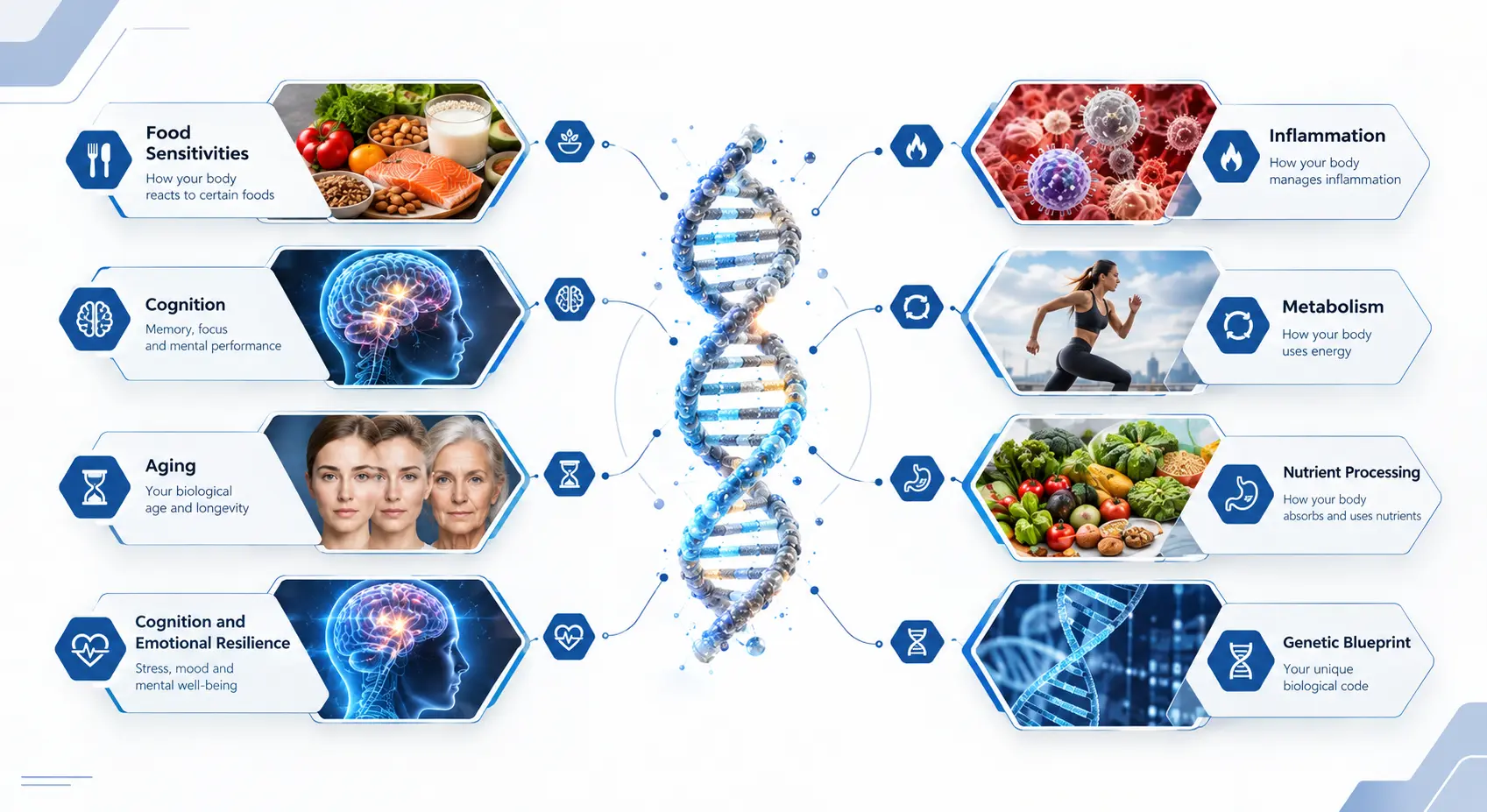
The information provided by DNA gene testing depends on the specific genetic panel.
Some testing panels are designed to provide insights into areas related to nutrition, metabolism, lifestyle, and other genetically influenced traits.
For example, a broader genetic assessment may examine markers associated with:
Metabolism
Certain genetic variations are associated with differences in metabolic pathways. Genetic testing can provide information about selected markers related to these pathways.
Nutrient Processing
Some genetic variants are studied in relation to how the body processes or utilizes particular nutrients.
Inflammation
Certain genetic markers have been investigated in relation to biological pathways involved in inflammation.
Cognition and Emotional Resilience
Some genetic variations are studied in connection with biological pathways associated with cognitive function and emotional responses.
Aging
Genetic research has identified numerous biological pathways associated with aging. Genetic testing can examine selected markers associated with these pathways.
Food Sensitivities
Depending on the test panel, genetic information may provide insights into selected biological factors related to food and nutrition.
It is important to distinguish genetic predisposition or association from a diagnosis. DNA results do not automatically mean that a person has a particular disease or condition.
What Affects the Accuracy of DNA Test Results?
Not all DNA tests look at the same information. The quality of a test depends on what it checks, how accurately it reads your DNA, and how well the findings are supported by research.
A useful DNA test should do three things well:
Read the DNA Correctly: The test needs to accurately identify the genetic markers included in the test.
Use Reliable Research: The results should be based on scientific research that shows how those genetic markers may relate to a trait or health area.
Give Results That Have Meaning: The findings should offer information that can be understood and used in the right context.
A DNA test does not need to examine every gene to be useful. What matters is whether it studies the genetic markers that are relevant to its purpose and explains the results clearly.
How Health Care Providers Can Use Genetic Insights
Genetic data can support a wider health discussion.A provider may already have useful information.They may know a person’s food habits. They may know their sleep pattern. They may know their activity level. They may also have lab results.
Genetic insights can add another layer.A provider may use a result to start a deeper conversation.The result may lead to more questions about nutrition. It may lead to questions about recovery or lifestyle.The result should still be viewed with other evidence.
What to Consider Before Choosing a DNA Testing Kit
Start with your reason for testing.Know what you want to learn.Then look at the test itself.What does it study?What markers are included?What will the report show?How does the company explain results?Privacy also matters.DNA data is personal.Read the privacy policy before you submit your data.
The National Library of Medicine also has a Genetic Testing Registry with information about many genetic tests.You can explore DNAlign Services to learn more about its genetic analysis services presented as a test of more than 198 unique SNPs across several wellness and performance areas.
What Should You Look for in a DNA Gene Testing Service?
Not all DNA gene testing panels are designed for the same purpose.
Before ordering a test, healthcare providers should review the test’s:
Genetic Markers
Look at which genes or SNPs are included rather than focusing only on the total number of markers.
Laboratory Process
Understand where and how samples are processed and what laboratory standards or certifications apply.
Reporting
Review how genetic results are presented and whether the report is understandable and relevant to the intended use.
Provider Support
A reliable ordering and support process can be important for practices incorporating genetic testing into their services.
Data and Privacy Practices
Genetic information is sensitive data. Providers should understand how samples and genetic information are handled, stored, protected, and shared.
Final Thoughts
DNA gene testing can give you information that is difficult to get from general health advice alone. By looking at specific parts of your DNA, it can provide insights related to areas such as nutrition, metabolism, exercise, recovery, and healthy aging.
The value comes from knowing what those results mean and how they fit with your health goals. A DNA test is not meant to replace your doctor, dietitian, or other qualified professional. It gives you another source of information to discuss and consider.
For people who want a more personal approach to wellness, the right DNA testing kit can be a useful place to start. DNAlign’s Genetic Optimization DNA Test examines more than 198 unique SNPs to provide insights across multiple areas of health and performance.
Explore the DNAlign Genetic Optimization DNA Test to learn more about what your genetic data may reveal.