Is Genetic Testing Worth It? DNAlign vs $100 DNA Kits Compared
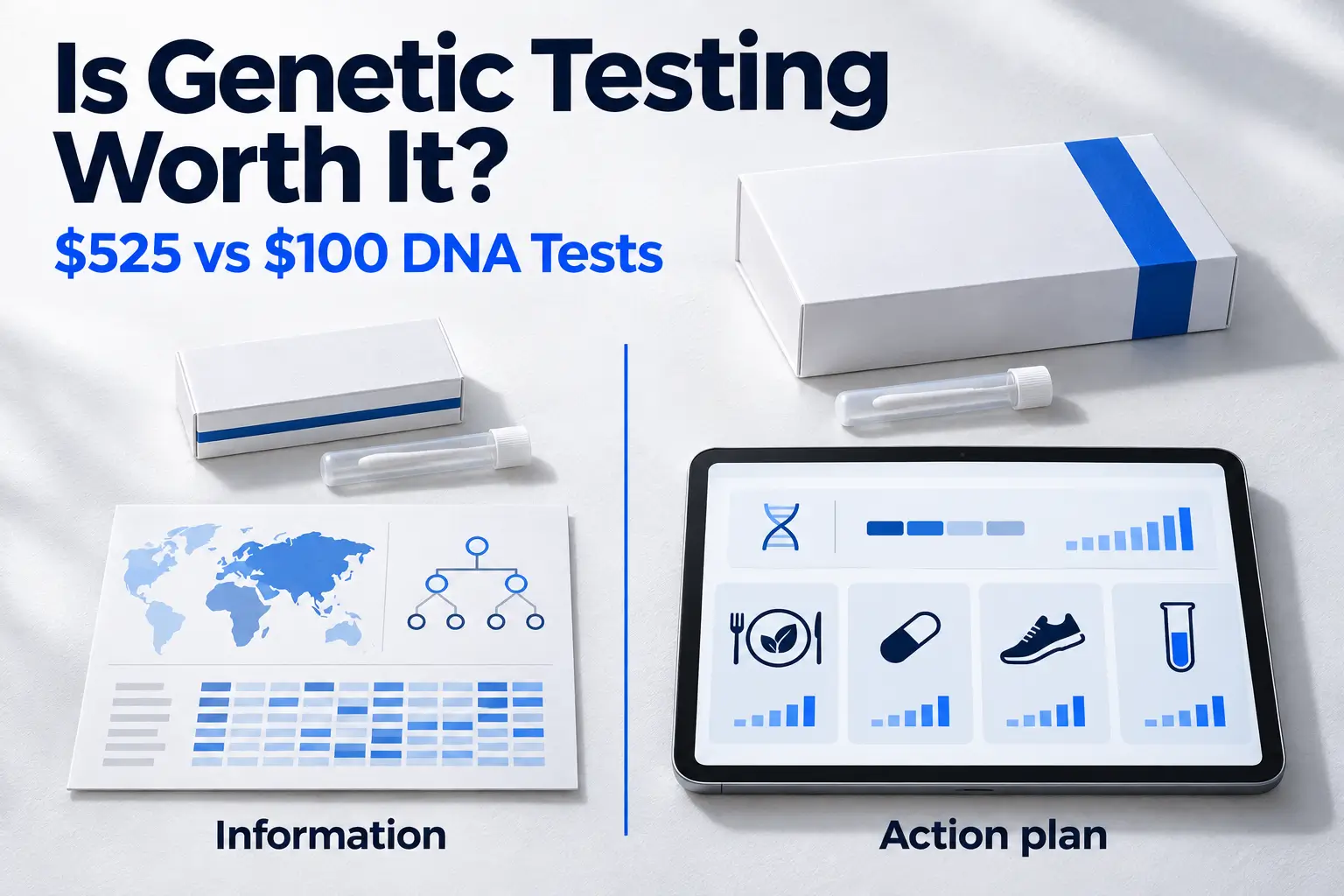
Is genetic testing worth it? For health, yes, if the test turns your results into specific changes to food, supplements, training and follow-up labs. A $100 ancestry kit mostly tells you where your family came from. A $525 health test like DNAlign is built to tell you what to do next.
The price gap is real, so this guide breaks down exactly what each tier buys you, where cheap kits fall short, where they’re the smarter pick, and how to decide in about five minutes. We’ll be upfront: DNAlign is our test. We’ll also tell you when you shouldn’t buy it.
Is Genetic Testing Worth It? The Short Answer
Genetic testing is worth it when the result changes a decision. For health, that means a report that names your genes, rates your risk, and gives specific nutrition, supplement and lab steps. Ancestry kits and basic trait reports rarely do that, so they’re worth it for curiosity, not health planning.
There are three broad kinds of DNA tests, and they answer very different questions:
| Test type | Typical price | Answers | Best for |
|---|---|---|---|
| Ancestry kit | $39 to $119 | “Where did my family come from?” | Family history, finding relatives |
| Consumer health report | $99 to $600 | “How might my genes affect my health and habits?” | Nutrition, fitness, prevention, wellness planning |
| Clinical diagnostic test | $249 to several thousand, often insurance-covered | “Do I carry a specific disease-causing variant?” | Hereditary cancer, pregnancy screening, diagnosis with a doctor |
A clinical test like BRCA screening for breast cancer risk, or genetic screening during pregnancy, is ordered by a doctor and often covered by insurance when there’s a personal or family history. Neither ancestry kits nor consumer health tests replace those.
What You Actually Get From a $100 DNA Kit
A $100 DNA kit gives you ancestry percentages, relative matching and a handful of trait or wellness reports. Most read hundreds of thousands of markers but turn only a small fraction into health insights. Health features usually cost extra or sit behind a yearly membership.
Here’s what the popular options cost in 2026, according to published price comparisons:
| Kit | Price | Health content |
|---|---|---|
| AncestryDNA | $99, or $119 with Traits | Ancestry and traits only, no health reports |
| MyHeritage DNA | $89 | Ancestry and relatives |
| 23andMe Ancestry Service | $99 | Ancestry and traits |
| 23andMe Health + Ancestry | $199 | Health predispositions, carrier status, wellness reports; premium membership renews yearly |
| SelfDecode kit | $99 | Kit only; the full report bundle is sold separately (up to $899) |
That last row shows the hidden cost of “cheap” testing. Many buyers pay $99 for a kit, then pay again to upload the raw data to a third-party interpretation service, then pay a yearly subscription to keep reports. The total can pass $500 anyway, with results spread across two or three companies.
Is 23andMe Health Worth It?
23andMe Health + Ancestry is worth it if you want ancestry and a broad health overview in one account. Its genetic health risk reports are FDA authorized for specific conditions. It’s less useful if you want detailed nutrition, supplement and lab guidance, which it doesn’t provide at depth.
The FDA’s 2017 authorization covered 23andMe reports for 10 conditions, including late-onset Alzheimer’s, Parkinson’s and celiac disease. That’s a real strength. But a risk flag without a plan leaves you asking “now what?”, which is the gap a nutrition-focused report is designed to fill.
Is an Ancestry DNA Test Worth It for Health?
No. AncestryDNA and similar kits are built for family history. Even trait add-ons cover things like taste preferences or hair type, not metabolism, nutrient processing or disease-related pathways. If health is your goal, an ancestry kit is the wrong tool at any price.
What a $525 DNA Health Test Includes
A $525 DNA health test should give you depth where cheap kits give breadth: named genes, your exact genotype, a risk rating, and a plan for each finding. The DNAlign test reads 400+ health-focused genetic markers and turns them into a report of about 170 pages, with no subscription.
Here’s what that looks like in practice:
- 400+ curated SNPs chosen for health relevance, not ancestry.
- 10 health sections, 44 categories: cognitive health, longevity, psychological resilience, micronutrient metabolism, metabolism and energy, food sensitivity, hormonal and reproductive health, musculoskeletal and physical performance, immune and cellular defense, and dermatology and aesthetics.
- Gene-level detail: every category shows the gene, its rsID and your genotype. For example, MTHFR rs1801133 for folate metabolism, COMT rs4680 for stress and focus, and APOE rs429358 for brain and heart health.
- A risk rating of High, Medium or Low for each category.
- Lifestyle and nutrition steps written for your result, such as specific foods, training types and sleep targets.
- Supplements to consider, with the purpose and preferred form of each. For an MTHFR carrier, that means methylfolate with B12 rather than plain folic acid.
- Follow-up labs to discuss with your doctor, such as homocysteine, RBC folate, vitamin B12, vitamin D and an omega-3 index, so you can confirm what your genes suggest.
- A CLIA-certified lab and results in about 10 to 14 business days.
- One payment of $525, with no membership and no add-on reports.
DNAlign vs $100 DNA Kits: Side-by-Side Comparison
DNAlign costs more because it’s a different product. Cheap kits sell ancestry with optional health extras. DNAlign sells only health analysis, with every reported marker tied to an action. If you compare by price per useful health insight rather than price per kit, the gap narrows sharply.
| Feature | $100 ancestry kits | $199 health + ancestry kit | DNAlign ($525) |
|---|---|---|---|
| Main purpose | Ancestry | Ancestry plus health overview | Health and optimization only |
| Markers | Hundreds of thousands, read broadly | 500,000+, read broadly | 400+, selected for health |
| Health categories | None or traits only | Health risks, carrier status, wellness | 44 categories across 10 sections |
| Gene, rsID and genotype shown | No | Some reports | Every category |
| Nutrition plan | No | Limited | Yes, per category |
| Supplement guidance | No | No | Yes, with purpose and form |
| Follow-up labs to ask for | No | No | Yes, per category |
| Report length | A few screens | Dozens of short reports | About 170 pages |
| Ongoing cost | Optional upgrades | Membership renews yearly | None |
| Ancestry and relatives | Yes | Yes | No |
Why More Markers Doesn’t Mean More Answers
A kit that reads 500,000 markers isn’t automatically more useful than one that reads 400. What matters is how many of those markers are interpreted for health and turned into advice. Most markers on ancestry chips exist to estimate ethnicity and match relatives, not to guide nutrition or prevention.
There’s also an accuracy issue with the “download your raw data and analyze it elsewhere” route. A 2018 study in Genetics in Medicine found that 40% of variants reported in direct-to-consumer raw data were false positives when retested in a clinical lab. Raw data was never designed for health interpretation by third parties. A test built for health, run in a certified lab and interpreted by the same company, avoids that gap.
Why DNAlign Costs More: Where the $525 Goes
The extra cost pays for health-focused marker selection, clinical-grade lab processing, and interpretation that turns each result into a written plan. A $100 kit spreads its cost across ancestry databases and relative matching. DNAlign puts its cost into the report you actually act on.
Here’s the practical difference, using one common finding:
- A $100 kit: shows nothing about MTHFR, or lists it in raw data you have to research yourself.
- A broad health kit: may mention a folate-related variant without a plan.
- DNAlign: shows your MTHFR genotype, explains its effect on folate and homocysteine, lists folate-rich foods, recommends methylfolate with B12 as the supplement form, and names homocysteine, RBC folate and B12 as the blood tests to ask your doctor for.
That sequence, gene to plan to lab confirmation, repeats across all 44 categories. It’s why the report runs to about 170 pages, and why one test can guide years of decisions. Your DNA doesn’t change, so you only buy it once.
For a deeper look at one area, see how this works in our guide to DNA nutritional analysis for men.
When a Cheaper DNA Test Is the Better Choice
A cheaper kit is the better choice when your goal isn’t health planning. If you want ethnicity estimates, family matches or a fun gift, a $99 ancestry kit does that better than any health test. And if you need a medical diagnosis, a clinical test through your doctor is the right route.
Choose a different test if:
- You want ancestry or to find relatives. DNAlign doesn’t do ancestry. AncestryDNA or MyHeritage will.
- You want a quick health overview on a tight budget. A $199 health and ancestry kit covers the basics.
- You have a family history of breast, ovarian or colon cancer. Ask your doctor about clinical hereditary cancer testing. Insurance often covers it when there’s a documented history.
- You’re pregnant or planning a pregnancy. Prenatal and carrier screening should go through your OB or a genetic counselor.
Choose DNAlign if you want a detailed, actionable plan for nutrition, supplements, fitness, stress and long-term health, and you’d rather pay once than stitch together kits, uploads and subscriptions.
How to Decide in 5 Minutes: A Buyer’s Checklist
The right DNA test is the one that answers your actual question. Start with your goal, then check five things: what the report covers, whether it shows genes and genotypes, whether it gives a plan, which lab runs it, and what it costs over time, not just on day one.
- Name your goal. Ancestry, a health overview, a detailed health plan, or a medical diagnosis.
- Check the coverage. Does it cover nutrition, metabolism, hormones, stress and longevity, or just traits?
- Look for gene-level detail. You should see gene names, rsIDs and your genotype, not just “you may like cilantro.”
- Look for a plan. Every finding should come with food, lifestyle, supplement and lab steps.
- Check the lab. It should be a CLIA-certified lab. CLIA sets federal quality standards for U.S. labs that test human samples.
- Add up the real cost. Include add-on reports, third-party uploads and yearly memberships.
- Ask for a sample report. If a company won’t show you one, that tells you something.
You can see how the DNAlign process runs from swab to report on our How It Works page, and compare more options in our guide to the best DNA test for health and fitness.
What a DNA Health Test Can’t Do
A DNA health test shows tendencies, not destiny or diagnosis. It can’t measure your current vitamin levels, confirm a disease, or account for sleep, stress and diet on its own. The FDA notes that different companies test different variants and recommends discussing results with a qualified provider.
That’s why the DNAlign report pairs every finding with follow-up labs. Genes tell you where to look. Blood work tells you where you stand today. Used together, they replace years of guessing. Our article on how DNA gene testing supports personalized wellness explains how to use both.
The Verdict: Is a $525 DNA Health Test Worth It?
A $525 DNA health test is worth it if you’ll act on the results. If you want a detailed plan for nutrition, supplements, training and lab testing, and you’d rather pay once than juggle kits and subscriptions, the depth justifies the price. If you want ancestry or a quick overview, a cheaper kit is fine.
Think of it this way: a $100 kit answers “what’s in my DNA?” DNAlign answers “what should I do about it?” If that second question is the one you care about, order the DNAlign Genetic Optimization DNA Test or contact our team to see a sample report first.
Frequently Asked Questions
Is genetic testing worth it?
Genetic testing is worth it when the results change what you do. For health planning, choose a test that shows your genes, rates your risk and gives nutrition, supplement and lab steps. For ancestry, a cheap kit is enough. For diagnosis, use a clinical test through your doctor.
Is 23andMe Health worth it?
23andMe Health + Ancestry is worth it if you want ancestry plus a broad health overview, including FDA-authorized risk reports for specific conditions. It is less useful for detailed nutrition, supplement and follow-up lab guidance, and its premium membership adds a yearly cost on top of the kit.
Why do some DNA tests cost more than others?
Price follows purpose. Ancestry kits spread costs across large relative-matching databases. Health-focused tests spend more on selecting health-relevant markers, certified lab processing and detailed interpretation. Clinical diagnostic tests cost most because they confirm specific disease variants and are reviewed for medical use.
Are at-home DNA tests accurate?
Tests run in CLIA-certified labs are generally accurate for the markers they are designed to read. Accuracy drops when raw data is uploaded to third-party tools; one 2018 study found 40% of variants in consumer raw data were false positives when clinically retested.
Is an ancestry DNA test worth it for health?
No. Ancestry DNA tests are built for ethnicity estimates and finding relatives. Their trait add-ons cover things like taste or hair, not metabolism, nutrient processing or hormone pathways. If your goal is health planning, choose a test designed and interpreted specifically for health.
How many markers does a DNA health test need?
There is no magic number. Ancestry chips read hundreds of thousands of markers, mostly for ethnicity and matching. A health test needs markers with known links to nutrition, metabolism and disease risk, each interpreted with clear advice. DNAlign reads more than 400 markers selected for health relevance.